
Three Agents, Three Different Conversations
By Rob Tucker ·
Walk through any office and you'll find agents at completely different points in their careers. Someone who got licensed four months ago. Someone who's been closing a steady number of deals for eight years. Someone doing more volume than half the office combined.
Now look at what most offices offer them. The same sales meeting. The same class calendar. The same "let me know if you need anything."
That's the problem. Those three agents don't want the same thing from you, and if you treat them the same, you'll lose at least one of them.
Here's how I think about each stage, and what a broker-owner should actually be doing for each one.

The new agent: the first paycheck, then the first $100,000
A brand-new agent has one thing on their mind: getting paid. Most of them have left another job or are living on savings. Until that first check clears, nothing else you say really lands.
So the first job is simple. Get them to a closing. That means helping them figure out who they already know, getting them in front of real buyers and sellers, and checking in often enough that a stalled deal doesn't turn into a lost one.
After the first paycheck, the goal changes to the first $100,000 year. That's where a plan matters. Start with the income they want, use their average sales price to work backward to how many closings that takes, and then to how many conversations a week. Now they have a number they can hit, not just a hope.
What they don't need yet: a lecture on building a team, or a dozen classes on tools they won't use for two years.

The experienced agent: the next level
The experienced agent is the one offices forget about. They're not new, so nobody's watching them closely. They're not a top producer, so nobody's courting them. They're producing steadily, and that makes them easy to ignore.
But a lot of them are stuck, and they know it. They want the next level, and for most of them that comes down to three things:
- More efficient. They're busy, and they've run out of hours. Help them find the tasks that eat their week and get those off their plate.
- More money. Not just more deals. Better deals, better clients, a better mix of business.
- Looking better for their clients. Better presentations, faster responses, a client experience people talk about. That's where the next round of referrals comes from.
This is the agent who leaves quietly. They don't complain. They just take a call from another office that finally asked them what they want. Ask them first.

The top producer: team, group, or something else
When I say top producer, I don't mean $2 to $5 million. I mean $10 million and beyond.
These agents don't need training. They already know how to sell. What they're wrestling with is a business decision: do they build a team, build a group, or do something else entirely? Do they want to lead people, or just get help? What happens to their own production if they start managing others?
Those are hard questions, and most of them have nobody to think them through with. If you can be that person, honestly, with their interests first, you're giving them something no split can match.
If you can't help with that decision, be honest about it and help them find someone who can. They'll remember that too.

Know which conversation you're in
Here's the simple version. Coach a top producer like a rookie, and they'll feel talked down to and leave. Coach a rookie like a top producer, and they'll feel lost and quit.
I've sold over 2,000 homes and recruited over 2,000 agents. Both taught me the same lesson: agents stay where someone knows what they're working toward.
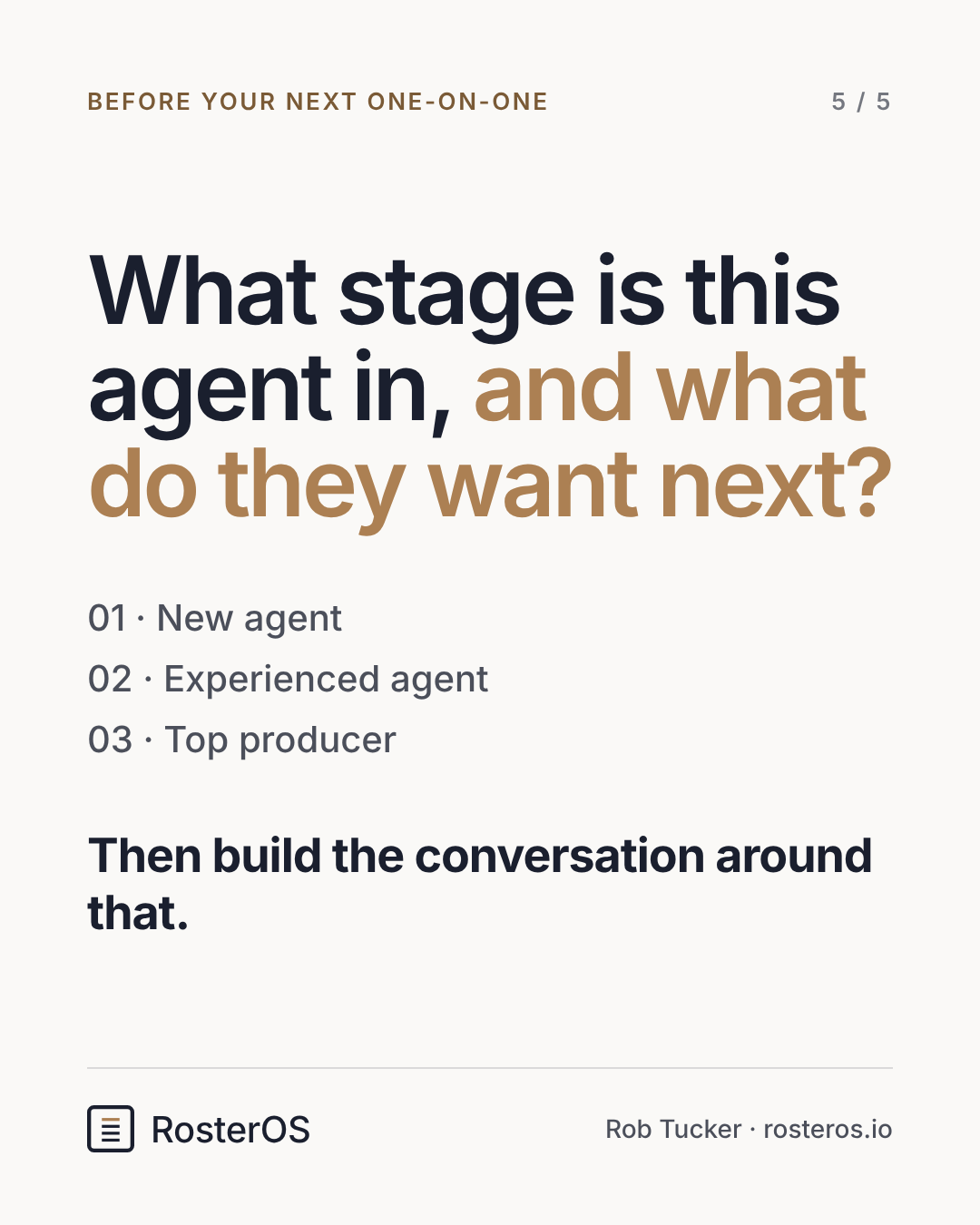
So before your next one-on-one, ask yourself two questions. What stage is this agent in? And what do they want next?
If you can't answer both, that's your first conversation.
Knowing where every agent on your roster is, and what they want next, is a big part of what I'm building at RosterOS. Learn more at rosteros.io.