
Recruited 4,000, Lost 4,000: You're Counting the Wrong Number
By Rob Tucker ·
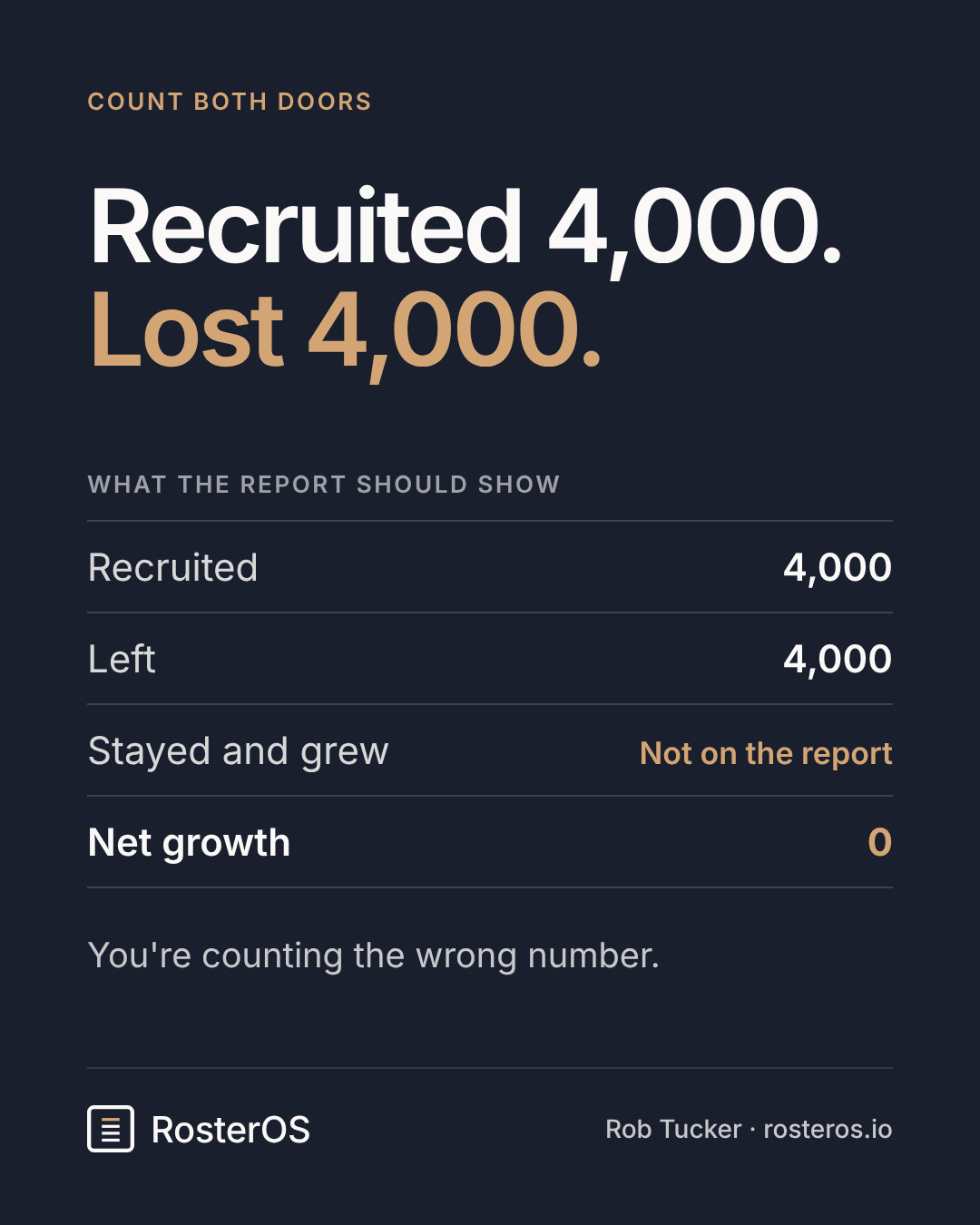
Picture two numbers on the same report. Agents recruited this year: 4,000. Agents lost this year: 4,000.
I've watched companies put up numbers like that. The first one gets announced at the awards dinner. The second one doesn't get announced anywhere. And when you put them side by side, the company is exactly the size it was a year ago, after spending a full year and a lot of money to stay there.
That's not a recruiting failure. The recruiters did their job. It's a scoreboard failure.
What gets measured is what gets done
A lot of companies measure the people running their offices on one thing: gross recruiting. How many agents came in. Hit the number and you're doing great. Miss it and you're on a call explaining why.
Think about what that teaches a leader. It teaches them that the agent who walked in last month matters more than the agent who's been producing for six years. It teaches them to spend their week on the front door and hope the back door takes care of itself.
It doesn't. Nobody is measured on the back door, so nobody is watching it.
What I count instead
I've recruited over 2,000 agents in my career, so I'm not against recruiting. I'm against counting only half of it.
Here's what I want on the report, every month, next to the recruiting number:
- Agents who left. By name, not just as a total. If you can't name them, you weren't paying attention to them.
- Agents who stayed and grew. More transactions, more volume, a better year than last year. This is the number that tells you whether your office is actually helping anybody.
- New agents who are still here and producing. Recruiting someone who's gone in eight months isn't a win. It's a cost.
- Net growth. In minus out. This is the only number that tells you whether the office got bigger.
When you put those four next to gross recruiting, the conversation in your office changes. You stop asking "how many did we sign?" and start asking "who are we about to lose, and why?"
The question you should be asking every week
Every week, I want to know who's drifting. Who hasn't had anything go under contract in a while. Who stopped showing up. Who's had a rough stretch and hasn't heard from anyone about it.
Those agents rarely announce that they're unhappy. They just quietly start taking calls from other offices. By the time they tell you they're leaving, the decision was made months ago.
If your report only counts the front door, you'll never see them coming. If it counts both doors, you'll see them in time to do something about it.
What this looks like in my own office
I run this in my own office, so I'll hold myself to it. In our first three months, we recruited 10 agents, about $800,000 in GCI.
Ten agents in the door is a start. It isn't the result. The result is whether those ten are still here a year from now, and doing more business than when they came. That's the number I'll be judged on, and it's the one I'd want you to ask me about.
Fix the scoreboard first
If you run an office, here's a simple place to start. Pull last year's numbers. Write down how many agents you brought in. Then write down how many left. Then write down how many of the agents you already had did more business this year than last.
Look at those three numbers together. If the second one is close to the first, more recruiting won't save you. You'll just be running harder to stay in the same place.
Count both doors. Then decide where to spend your week.
Counting both doors, and catching the agents who are drifting before they leave, is a big part of what I'm building at RosterOS. Learn more at rosteros.io.